 2301 S Broadway Ave A6 Tyler, TX 75701


Which Coins in Your Home Are Actually Worth Money? A Tyler Seller’s Guide
Most people assume old coins are worth face value or perhaps a few cents above it. Some of the most commonly overlooked coins sitting in drawers, jars, and inherited collections across Tyler and East Texas are worth significantly more than face value, and a few are worth hundreds or even thousands of dollars. The challenge is knowing which ones to pay attention to and which are genuinely ordinary. This guide walks you through the categories that matter, the signs to watch for at home, what is usually not worth as much as it looks, and when to bring coins to a professional buyer in Tyler for a proper evaluation.
At Tyler Gold & Bullion, we are licensed by the Texas Office of Consumer Credit Commissioner (OCCC) as a certified precious metal buyer. Our scales are certified by the Texas Department of Agriculture, and our GIA-certified appraisers evaluate coins using both numismatic expertise and Thermo-Fisher XRF technology for metal content confirmation. Tyler residents rate us 4.9 stars on Google. Every coin evaluation at our Tyler location is free. You leave with information whether you sell or not.
Why Most People Underestimate (or Overestimate) What They Have
The inability to identify which coins carry real value beyond face value leads to two opposite and equally costly problems. Some Tyler residents have donated, spent, or discarded coins worth far more than they realized. Others have held onto every coin for decades hoping to find a fortune, not realizing that most standard circulated coins are worth exactly what they say on the face.
Both mistakes happen because coin valuation involves specific knowledge that most people never have a reason to learn. A 1964 Roosevelt dime and a 1965 Roosevelt dime look nearly identical. One is 90% silver and worth well above its face value. The other is a base metal coin worth exactly 10 cents. The difference is not visible at a glance.
Our blog on how gold, silver, and collectible coins are valuated explains the valuation framework in detail. This guide focuses specifically on helping you identify which coins are worth a closer look before you visit our Tyler location.
Why Coin Values Are So Hard to Identify Without Training
The numismatic market is deep and specialized. Two coins that look almost identical to a casual observer can be worth dramatically different amounts based on factors that are not visible without specific knowledge.
- Most people have no formal coin education and there is no everyday reason to acquire it.
- Online searches return overwhelming, inconsistent, and often misleading information about specific coin values.
- The factors that drive value (date, mint mark, grade, variety) are subtle and require experience to assess.
- Inherited collections come with no documentation and no one left to explain what the original owner knew about them.
- Fear of embarrassment keeps many Tyler residents from visiting a professional even when they suspect they might have something worthwhile.
Warning Signs a Coin in Your Collection Might Be Worth More
Before looking up anything online, run through these quick checks on coins from older collections. Each one is a signal worth paying attention to.
- The coin is dated 1964 or earlier and is a dime, quarter, or half dollar.
- The coin has a solid silver edge when viewed from the side, with no copper-colored stripe visible.
- The coin is significantly heavier than a modern coin of the same denomination.
- The coin shows a small letter stamp near the date (D for Denver, S for San Francisco, CC for Carson City, O for New Orleans).
- The coin is housed in a hard plastic holder with a printed grading label from a third-party service.
- The coin is a large silver dollar from an earlier era (Morgan or Peace dollar style) rather than a modern dollar coin.
Coin Types Tyler Residents Find That Are Actually Worth Money
Pre-1965 Silver Dimes, Quarters, and Half Dollars
The U.S. Mint stopped including silver in circulating dimes, quarters, and half dollars after 1964. Every dime, quarter, and half dollar with a date of 1964 or earlier contains 90% silver. These are called junk silver in the trade, not because they are worthless, but because they are valued primarily for their silver content rather than for collector reasons.
A pre-1965 quarter contains approximately 0.18 troy ounces of silver. At any meaningful silver price, a roll of 40 pre-1965 quarters represents significant silver value well above face. These coins are extremely common in older collections and often get mixed in with modern change. The simplest identification method: look at the edge. Pre-1965 coins show a solid silver edge. Post-1964 coins show a visible copper stripe on the edge.
Morgan Dollars and Peace Dollars
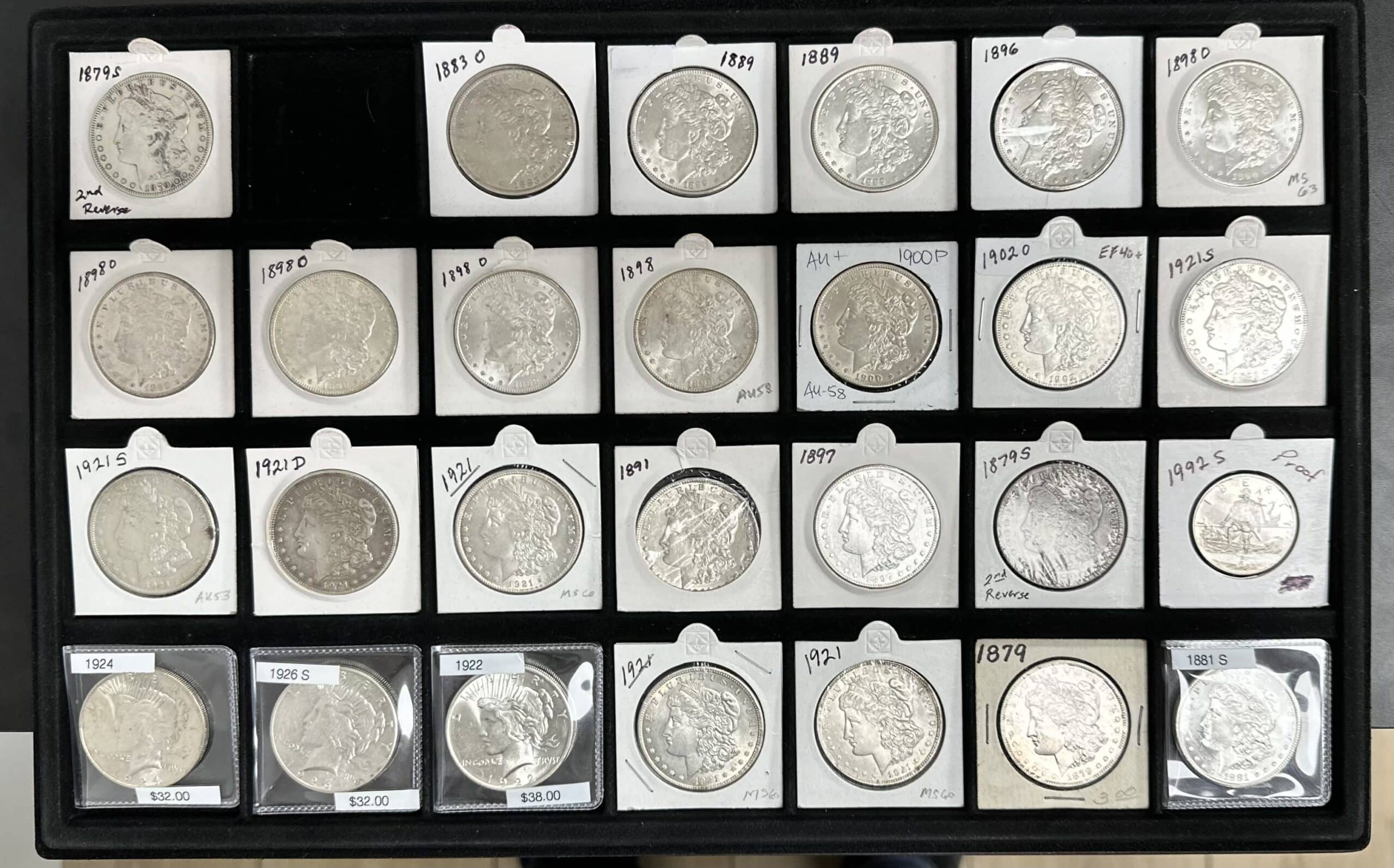
These large silver dollars, minted between 1878 and 1935, are among the most actively traded collectible coins in the United States. Each contains 0.7734 troy ounces of silver. Their collector value varies dramatically based on date, mint mark, and condition. Common dates are worth primarily their silver content. Key dates like certain San Francisco and Carson City mint issues can be worth hundreds or thousands of dollars in grades that do not look exceptional to the untrained eye.
If you find Morgan or Peace dollars in an inherited collection, do not clean them and do not assume they are common without having them evaluated. Before your visit, read our guide on what Tyler coin dealers want sellers to know before bringing in Morgan and Peace dollars.
Gold Coins
American Gold Eagles, American Gold Buffalos, Canadian Gold Maple Leafs, South African Krugerrands, and pre-1933 U.S. gold coins all carry significant gold content value. Pre-1933 U.S. gold coins, including $5, $10, and $20 gold pieces, also carry numismatic premiums in many grades because they are no longer produced and represent a documented chapter in American monetary history.
If you find any coin that appears gold-colored and feels genuinely heavy for its size, treat it carefully and bring it for professional evaluation. Do not clean it. Gold coins represent some of the highest-value items in everyday inherited collections and deserve proper assessment from a buyer who understands both the gold content and the collectible market. Our collectible coins page outlines how we approach both aspects.
Certified Coins in PCGS or NGC Holders
If you find any coins in sealed hard plastic holders with printed labels from a grading service, these deserve specific attention. The Professional Coin Grading Service (PCGS) and Numismatic Guaranty Company (NGC) are the two most recognized independent coin grading services in the world. A coin in one of these holders has been independently authenticated and assigned a grade on a standardized scale. The holder significantly increases market confidence and often supports higher values.
Do not attempt to remove coins from PCGS or NGC holders. The holder is part of the coin’s documented history and removing it destroys the certification. Bring them as found. Our coin evaluators read and recognize PCGS and NGC holders and factor them appropriately into the appraisal.
Key-Date Lincoln Cents and Buffalo Nickels
Most Lincoln cents and Buffalo nickels in circulation are worth face value or a few cents above. A small number of specific dates and mintage varieties command prices that feel extraordinary for such a common-looking coin. The 1909-S VDB Lincoln cent, 1914-D Lincoln cent, and 1922 plain (no D) Lincoln cent are well-known high-value issues. The 1913-S Type 2 Buffalo nickel and 1916 doubled die Buffalo nickel are similarly elevated.
These specific issues require experienced eyes to identify. If you have Lincoln cents dated before 1960 or Buffalo nickels (any date), sort them aside for professional review rather than assuming they are all common.
How to Sort Your Coins at Home Before Visiting Tyler Gold & Bullion
You do not need to identify exact values before visiting. A basic sort helps the appraisal move efficiently and ensures nothing valuable gets missed. Follow these steps.
- Separate all coins dated 1964 and earlier. Set these aside as a priority group.
- Check the edges of those pre-1965 coins for solid silver (no copper stripe).
- Separate any large silver dollar-sized coins into their own group.
- Set aside any coins in sealed plastic grading holders.
- Separate any coins that appear gold-colored and feel notably heavy for their size.
- Do not clean any coin at any point in this process.
Even if you do none of this sorting in advance, bring your coins as they are. Our coin evaluators handle all identification during the free appraisal. Read more about what to expect during a professional coin appraisal in Tyler before your visit.
Coins That Look Impressive But Usually Have Limited Value
Managing expectations is as valuable as identifying genuinely rare coins. These common items generate repeated questions from Tyler sellers who are understandably curious.
- Presidential dollar coins (the large golden-colored coins minted from 2007 onward): not gold, not silver. Worth face value unless in certified proof condition.
- Commemorative coins sold through direct mail in the 1970s, 1980s, and 1990s: most are clad or low-silver issues. Many are worth slightly above face value at best.
- Wheat pennies (1909 to 1958): most are worth 3 to 5 cents apiece. A small number of key dates are valuable, but the vast majority are not.
- 1976 Bicentennial quarters, dimes, and half dollars: the standard circulating versions are worth face value. Silver proof versions (sold by the U.S. Mint in collector sets) have some silver value.
- Foreign coins from most countries: many are base metal and trade at or near face value. Some older foreign silver coins have silver content worth evaluating. Do not discard without checking.
- Reproduction and replica coins sold as antiques or novelties: these are modern reproductions and contain no precious metal content, regardless of appearance.
Why Inherited Coin Collections in East Texas Deserve Professional Review
Tyler and the surrounding East Texas region have active estate sale markets, particularly during the summer months following graduation and estate settlements. Coin collections frequently change hands at estate sales in Smith County, sometimes being picked up by dealers who recognize value that the estate did not.
Families that have held gold and silver over multiple generations often have coins tucked into boxes, drawers, and safe deposit boxes that have not been reviewed since they were originally accumulated. A free coin evaluation at Tyler Gold & Bullion ensures that those items receive a proper professional review before any decision is made. Our blog on maximizing your returns when selling rare and collectible coins offers additional guidance for anyone sitting on a larger inherited collection.
If your collection is incomplete or you are wondering about selling a partial set, our blog on what to expect when selling a partial coin collection addresses exactly that situation.
Why Tyler Residents Bring Their Coins to Tyler Gold & Bullion
| What We Offer | What It Means for You |
|---|---|
| Licensed by the Texas OCCC | State-certified precious metal buyer operating under regulatory oversight |
| Texas Dept. of Agriculture certified scales | Accurate weight measurements verified by state standards |
| GIA-certified appraisers | Professionally trained evaluators for both bullion content and collector value |
| Numismatic and bullion expertise | We evaluate coins as both metal content and collectible items, not just one |
| Thermo-Fisher XRF technology | Non-destructive metal composition testing confirms silver and gold content accurately |
| Free coin appraisals | No charge for evaluation, no obligation to sell, no minimum quantity |
| Transparent on-counter process | You see identification, testing, and every calculation as it happens |
| Rated 4.9 stars on Google | 4.9-star rating from Tyler residents who recognized our honest, thorough coin evaluations |
FAQs About Identifying Valuable Coins in Tyler, TX
How do I know if the old coins I found are worth more than face value?
The most reliable indicators are age and composition. Dimes, quarters, and half dollars dated 1964 or earlier contain 90% silver and are worth above face value at any meaningful silver price. Large silver dollars from before 1936 (Morgan and Peace dollars) contain significant silver. Any coin in a PCGS or NGC grading holder has been professionally authenticated. A free evaluation at Tyler Gold & Bullion is the most accurate way to determine what you have.
What are pre-1965 silver coins and why are they valuable?
Pre-1965 U.S. dimes, quarters, and half dollars contain 90% silver. The U.S. Mint stopped including silver in circulating coins after 1964. These coins are valued primarily for their silver content, which is substantial relative to their face value. A pre-1965 quarter contains approximately 0.18 troy ounces of silver. At current silver prices, they are worth well above the 25-cent face value.
Are all Morgan Dollars valuable, or just certain ones?
Most Morgan Dollars are worth their silver content plus a modest premium. Certain specific dates and mint marks, known as key dates, are significantly more valuable due to low original mintage or high attrition over time. The 1893-S, 1895, and 1889-CC are among the most notable examples. Most common date Morgan Dollars in average circulated condition are worth their silver content plus a small collector premium. Professional evaluation determines which category your specific coin falls into.
What is a mint mark on a coin and why does it affect value?
A mint mark is a small letter stamped on a coin indicating which U.S. Mint facility produced it. Common marks include D (Denver), S (San Francisco), CC (Carson City), and O (New Orleans). Certain mint facilities produced far fewer coins of specific dates than others, creating scarcity that drives collector value. The same coin design from the same year can be common from one mint and rare from another. Mint marks are usually found near the date on the coin’s obverse.
Should I clean my old coins before bringing them to Tyler Gold & Bullion?
No. Never clean coins before an appraisal. Cleaning removes original surface patina, which collectors and graders value as evidence of a coin’s unaltered history. Cleaned coins receive lower grades and can lose significant value. Tarnish and light wear are normal and do not disqualify a coin from appraisal. Bring coins in their current condition. This applies equally to gold, silver, and base metal coins.
What does a PCGS or NGC holder mean for my coin’s value?
PCGS and NGC are the two most trusted independent coin grading services. A coin in one of these holders has been professionally authenticated and assigned a standardized grade. The holder documents the coin’s identity and condition. Certified coins often sell for premiums above uncertified examples of the same coin and date because the certification reduces uncertainty for buyers. Do not remove coins from their holders. The holder is part of the item’s documented value.
Are commemorative coins from the 1970s and 1980s worth selling?
Most commemorative coins sold through direct mail programs in the 1970s and 1980s have limited precious metal content and modest collector demand. Many are clad (base metal) with thin plating, worth face value or a small premium. Some silver proof commemoratives from U.S. Mint sets have genuine silver content worth evaluating. Bring them in for a free evaluation. Our appraisers will identify what you have and give you an honest assessment.
Can I tell if a coin contains silver just by looking at it?
For U.S. dimes, quarters, and half dollars, checking the edge is the most reliable visual check. Pre-1965 coins show a solid silver edge with no copper stripe. Post-1964 coins show a clearly visible copper-colored stripe on the edge. For larger silver dollars, the heft and color provide clues, but a professional test is needed for certainty. Appearance alone is not reliable for foreign coins or older coins with heavy wear.
Are wheat pennies valuable?
Most wheat pennies (Lincoln cents from 1909 to 1958) are worth 3 to 5 cents each in well-worn circulated condition. A small number of specific dates and mintmarks, including the 1909-S VDB, 1914-D, and 1922 plain, are worth significantly more. If you have a large quantity of wheat pennies, sorting through them for key dates before or during a professional evaluation is worthwhile. Do not discard wheat pennies in bulk without checking for these specific issues.
What is a key-date coin?
A key-date coin is a specific date and mint mark combination within a coin series that was produced in unusually low quantities or suffered high attrition, making surviving examples scarce. Key dates command prices significantly above other dates in the same series. Identifying key dates requires knowledge of the specific series. Our coin evaluators identify key dates as part of every free coin appraisal at Tyler Gold & Bullion.
What are junk silver coins and are they worth selling in Tyler?
Junk silver refers to pre-1965 U.S. dimes, quarters, and half dollars valued primarily for their 90% silver content rather than for numismatic reasons. The term is a trade description, not a commentary on quality. These coins represent straightforward silver value and are actively purchased at Tyler Gold & Bullion based on current silver market pricing. A jar or roll of pre-1965 coins can represent meaningful silver value worth converting to cash.
How does the condition of a silver or gold coin affect its value?
Condition affects value differently depending on the coin type. For bullion coins valued primarily for metal content, condition matters less because the silver or gold content is constant. For collectible coins like Morgan Dollars and key-date Lincoln cents, condition (or grade) can multiply value dramatically. A Morgan Dollar in mint state condition can be worth ten to twenty times a heavily worn example of the same date and mint mark.
I inherited a large coin collection. What should I do before bringing it in?
Do not clean anything. Do not sort by attempting to identify values yourself unless you have numismatic knowledge. Separate coins that are visibly in sealed PCGS or NGC holders. Set aside any large silver dollar coins and any coins that appear gold-colored. Bring the full collection as it is. Our coin evaluators handle all identification, sorting, and testing during the free appraisal. There is no minimum quantity and no obligation to sell anything after the evaluation.
Does Tyler Gold & Bullion buy foreign coins?
Yes, we evaluate foreign gold and silver coins. Many foreign gold coins from Great Britain, Mexico, South Africa, and Canada contain known gold content and trade actively in the precious metals market. Older foreign silver coins from various countries contain meaningful silver. Base metal foreign coins from most modern countries do not have precious metal content and are generally not purchased. Bring any foreign coins you are uncertain about for a free evaluation.
Can I sell a partial or incomplete coin collection to Tyler Gold & Bullion?
Yes. There is no requirement to have a complete set to sell. Individual coins, partial rolls, incomplete sets, and mixed collections are all evaluated and purchased. Each coin is assessed individually on its own merits. You do not need the full original set to receive fair value for the coins you do have. For more details on this situation, read our guide on what to expect when selling a partial coin collection.
Bring Your Coins to Tyler’s Coin Experts for a Free Evaluation
The most important step is also the simplest one: bring your coins in for a free professional evaluation before making any decision. Tyler Gold & Bullion evaluates gold coins, silver coins, certified coins, junk silver, and inherited collections of every size. Our coin appraisers understand both the metal market and the collector market, which means you receive fair value regardless of what type of coins you have.
Visit us at 2301 S Broadway Ave A6 in Tyler, TX. Our OCCC-licensed team evaluates every coin in front of you and explains what they found in plain language. See our full collectible coins page and our complete list of items we buy before your visit. For beginners, our guide on navigating the world of collectible coins is a useful starting point. Call 903-522-4149 with questions before your visit, or stop by Monday through Friday from 10am to 4pm. The evaluation is always free.